
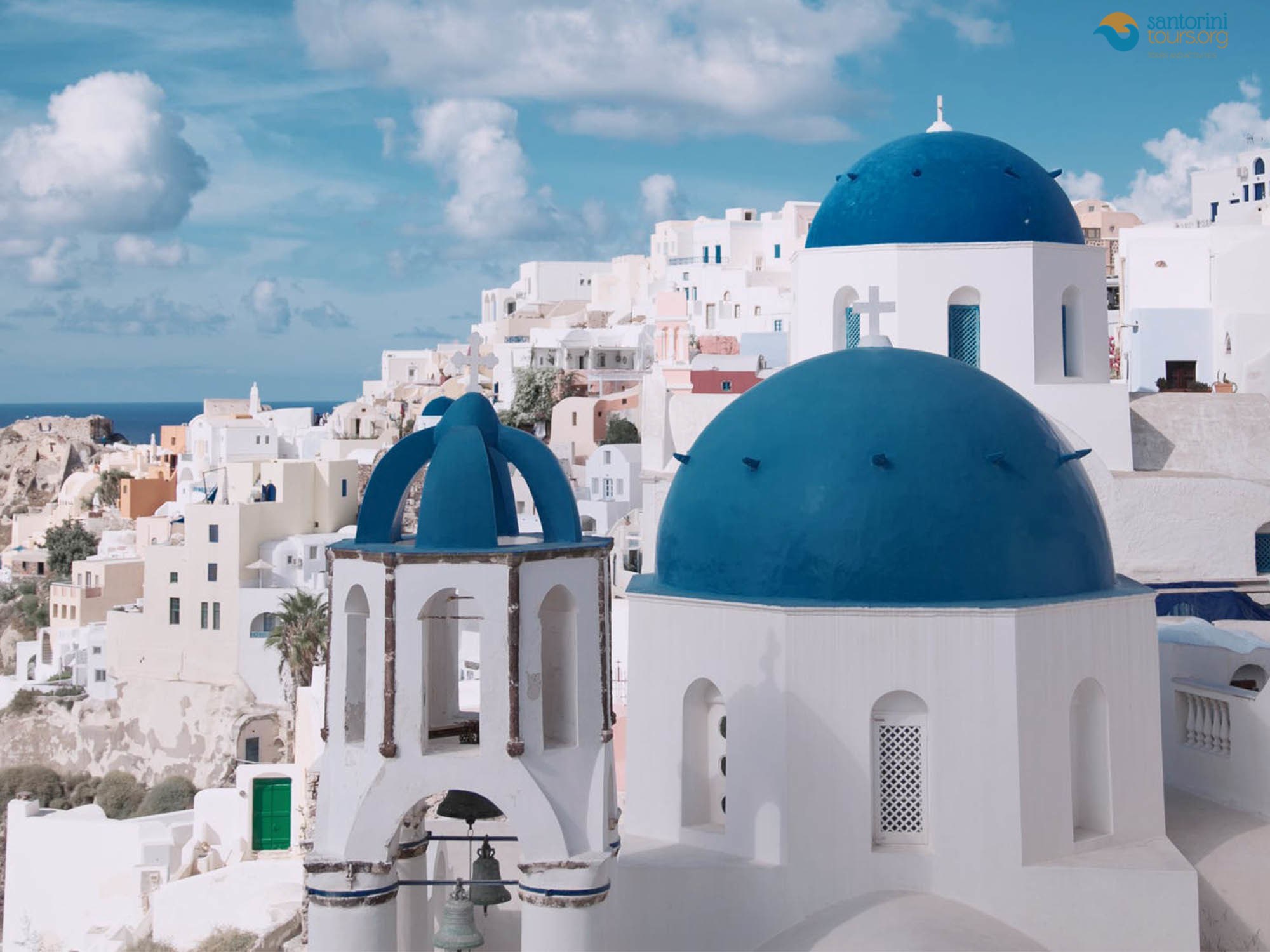
The Santorini sunset is the most famous thing about the island and the most reliably disappointing. Not because it is overrated — the sun dropping into open water beyond a flooded volcanic crater genuinely is one of the great sights in Europe — but because almost everybody watches it from the same two-metre-wide walkway at the same moment, and then discovers there is one road out.
This guide ranks every viewpoint honestly, covers what time it actually happens across the year, and explains how santorini tours schedule around it. The short version is that the sunset is worth planning for and Oia is rarely the right answer.
For travellers planning the island, santorini tours and santorini tours offer expertly guided experiences across Santorini — from caldera sunsets and volcano walks to private wine tastings and tailor-made sightseeing.
Where Do Santorini Tours Watch The Sunset?
Most end in Oia; the better ones end at Imerovigli, Skaros or Profitis Ilias.
Every viewpoint on santorini tours sees the same sun set over the same caldera. What differs is the number of people between you and it, and how long it takes to leave afterwards.
Oia concentrates several thousand visitors onto a narrow clifftop walkway, and afterwards they all leave along a single road where a taxi is effectively unobtainable. Santorini tours ending anywhere else drive away in five minutes with the same photographs.
Why Do Santorini Tours Default To Oia?
Because it is what customers expect to be sold, not because it is the best view.
On santorini tours Oia's reputation is genuinely earned — a whitewashed village on a headland with a ruined castle at its western tip, and the sun setting over open water beyond it. In April or October it is lovely.
In season it is a crowd-management exercise. Operators run it because it is the image people booked, and most published santorini tours would lose customers by proposing anywhere else. Asking where a tour watches sunset separates operators more sharply than price does.
Do Santorini Tours Prefer Imerovigli To Oia?
Compositionally yes, and practically by a wide margin.
On santorini tours Imerovigli sits at the highest point of the caldera rim, known locally as the balcony of the Aegean. The view west takes in the crater, the volcanic islets and — crucially — Oia itself, lit up on its own headland in the middle distance.
That gives the frame depth and a subject, where Oia’s own view is sun over open water. It also has room to stand, no coach parking and an immediate exit. Santorini tours increasingly end here, and it is the single most useful thing to request.
What About Skaros Rock On Santorini Tours?
The most dramatic option, fifteen minutes on foot below Imerovigli.
On santorini tours Skaros is the volcanic promontory that held the island’s medieval capital until earthquakes made it untenable. The path drops from Imerovigli onto the saddle with the caldera on three sides, and a rougher continuation leads to the chapel of Theoskepasti on the far side.
Read more: Santorini Sightseeing Tour
It is steep in places with a loose surface, so proper shoes matter. Shared santorini tours rarely allow the time; on a private day it is an easy addition to an Imerovigli stop and it removes you from the crowds entirely within five minutes.
Is Profitis Ilias Worth The Drive On Santorini Tours?
Yes, for the widest view on the island and the easiest exit.
At 567 metres it is Santorini’s highest point, topped by an eighteenth-century monastery, with a panorama covering the caldera, both coasts, the farmland and the surrounding islands. It is the only place that shows the shape of the whole island at once.
It has parking, space and almost nobody there. The trade is distance from the rim villages, which makes it a natural finish for santorini tours that spent the afternoon inland around Pyrgos and the wineries.
Do Santorini Tours Watch The Sunset From A Winery?
Several estates have west-facing terraces, and it is the most comfortable version available.
On wine santorini tours a tasting timed to finish at sunset delivers the same caldera view as the crowded viewpoints, with a seat, a glass and no queue to leave. The winery belt around Pyrgos, Megalochori and Exo Gonia sits on the island’s gentler slope with clear sightlines west.
It is the arrangement most often requested by couples and repeat visitors, and it costs nothing extra beyond the tasting. Wine-focused santorini tours that finish this way solve the sunset and the last stop in one move.
Is The Sunset Better On Boat Santorini Tours?
Different, and for many people better.
On boat santorini tours the sun drops beneath Oia with the village lit above you on the cliff, a drink in hand, and nobody queueing anywhere. Compositionally it has more in it than the view from Oia itself: the caldera wall, the village on its headland, and the light on the water.
Read more: Santorini Semi Private Small Group Sightseeing Private Tour
Catamaran santorini tours departing mid-afternoon finish this way as standard, and it is the one version that ends without any scramble for transport. Sunset sailings sell out first in season for exactly that reason.
What Time Is Sunset On Santorini Tours?
Around 20:50 at midsummer, 19:45 in early September, 18:45 in late October, 17:20 in December.
For santorini tours the swing across the year is nearly three and a half hours, which reshapes the whole evening. In June a tour can finish at a viewpoint and still leave time to eat afterwards; in October the two collide.
It also changes what a day can hold. Long June evenings absorb the most ambitious itineraries comfortably; in late October the same route has to be tighter. Worth confirming which shape a tour is offering, because santorini tours in the late season often build dinner in rather than finishing before it.
How Early Do Santorini Tours Arrive For Sunset?
Ninety minutes before at Oia in season; twenty minutes anywhere else.
On santorini tours Oia's castle ruin and the walkway fill from about an hour and a half before the sun drops between June and September. Arriving later means standing behind people rather than looking at anything.
Imerovigli, Skaros and Profitis Ilias need no such margin in any month. That difference — ninety minutes of your evening — is the hidden cost of the default choice, and it is why santorini tours that go elsewhere fit more into the same day.
Should Santorini Tours Stay For Blue Hour?
Yes, and almost nobody does.
On santorini tours the twenty to thirty minutes after the sun drops are when the villages switch their lights on while the sky still holds colour. The caldera turns deep blue, the whitewash picks up the warm interior lights, and the crowd has already left.
It is when the photographs everyone actually wants appear. Standard santorini tours depart at sunset because that is when the schedule says the day ends; staying another twenty-five minutes produces the better image and it is worth agreeing with a private driver in advance.
Read more: Santorini Full Day Tour
Where Should Photography Santorini Tours Go?
Imerovigli for sunset, then stay put for blue hour.
For photography santorini tours the elevation is higher than Oia, there is room for a tripod, and Oia in the middle distance gives the composition a subject. The blue domes on Oia’s own northern edge face north-west and work in late light, but the walkway is impassable with a tripod in season.
What a private booking buys here is waiting time — the licence to stand somewhere for twenty-five minutes while the light arrives. No shared schedule can accommodate it, which is why photographers on santorini tours book privately.
Is The Sunset On Santorini Tours Different By Season?
The sun is the same; the crowd and the sky are not.
For santorini tours July and August deliver the most reliable clear skies and the worst congestion. Late September and October bring longer golden hours, more atmospheric cloud and a noticeably thinner crowd. Winter offers empty viewpoints and dramatic low light, with an early finish.
The shoulder months are the genuine sweet spot: everything open, room to stand, and softer light than midsummer’s hard clarity. Santorini tours in May or October reach a viewpoint without needing an early claim on a space.
Can You See The Sunrise Over The Caldera?
No — the caldera faces west. The sun rises behind the villages.
This surprises people planning santorini tours. What you can watch at sunrise is the east coast: Kamari and Perissa with the sun coming out of the sea behind Mesa Vouno, or Ancient Thera on the ridge above them.
The better dawn activity on the rim is Oia itself, which is empty before eight and photographable without waiting. Few santorini tours run early enough, so it is usually a self-organised outing — and it is the single most valuable hour available on the island.
How Do Santorini Tours Leave Oia After Sunset?
With a vehicle waiting at an agreed point, or you do not leave quickly.
Read more: Santorini Private Impressive Tour with Local Snacks at Black Sand Beach
After santorini tours several thousand people depart a village served by one road within the same twenty minutes. Taxis are unobtainable, the buses fill immediately, and the walk out is long and dark.
This is the single worst logistical moment on the island and it catches independent visitors every evening. Anyone on organised santorini tours has a driver at a named point; anyone who arrived by bus is queueing for an hour or more.
Where Do Santorini Tours Eat At Sunset?
Book weeks ahead for a caldera-view table, or eat inland afterwards.
After santorini tours, sunset tables in Oia and Imerovigli are the hardest reservation on the island in season and are not included in any tour price. The premium is for the terrace; the cooking is generally competent rather than exceptional.
The alternative is to watch from a free viewpoint and eat inland afterwards at Pyrgos, Megalochori or Exo Gonia, where the kitchens are better and cheaper. Operators of santorini tours will make either booking if asked, and have better luck than a foreign phone number.
Should Santorini Tours Be Built Around The Sunset?
Worth building the last two hours around; not the whole day.
On santorini tours the mistake is treating sunset as the destination and everything before it as filler. That produces a late start, a day spent behind the coach flow, and an evening in a crowd.
The better shape runs the opposite way: an early start, the villages while they are empty, the archaeology through the midday heat, a winery in the late afternoon, and a viewpoint at the end. Santorini tours built like that get the sunset and a good day rather than one at the expense of the other.
What Do Visitors Regret About Sunset Santorini Tours?
Going to Oia in season, and leaving before blue hour.
On santorini tours both are avoidable and neither costs anything to fix. Visitors who watch from Imerovigli describe the evening warmly; those who watched from the Oia walkway in August describe a crush.
Read more: Santorini South Part Tour
And almost everyone who leaves at sunset regrets not staying the extra twenty-five minutes, because that is when the lights come on and the island looks the way it does in the photographs that brought them there.
Why Does The Caldera Sunset Look The Way It Does?
Because you are looking west across eleven kilometres of open water inside a volcanic crater, with nothing built on the far side.
Unlike santorini tours, most famous sunsets are watched across a bay or a horizon. Here the foreground is a flooded caldera up to 400 metres deep, the middle distance is two black volcanic islets, and the far rim is Thirassia — uninhabited enough that no lights interrupt the line.
Santorini from the air: the caldera, the villages and the cliffs.
The rim villages sit 300 metres above the water on the eastern edge, which means the light comes at you across the crater rather than along a coast. That elevation and that emptiness are what produce the effect, and they are the reason no other Cycladic island has anything comparable.
It also explains why the viewpoint matters less than people assume. Every position on the western rim shares the same geometry, which is why santorini tours ending at Imerovigli deliver the same sunset as those ending at Oia.
How Does The Meltemi Affect The Sunset?
It clears the sky and makes the exposed viewpoints uncomfortable.
For santorini tours the meltemi is a dry northerly that blows hard through midsummer, and its effect on the evening is double-edged. It strips humidity and haze, which produces the sharp clear sunsets July and August are known for, and it makes an exposed clifftop genuinely cold and difficult to stand on for an hour.
A caldera viewpoint at sunset is markedly cooler than the afternoon that preceded it, and colder again on a boat. A light windproof layer is the most commonly forgotten item on santorini tours, and the evening is when its absence is felt.
On a strong meltemi day the sheltered options are better: a winery terrace on the eastern slope, or Profitis Ilias where there is a building to stand behind.
Read more: Santorini Full Day Tour
Which Viewpoint Suits Limited Mobility?
Profitis Ilias and the Firostefani rim — both reachable more or less from a vehicle.
On accessible santorini tours Profitis Ilias has parking at the summit beside the monastery, with the panorama immediately available and no walking required. Firostefani’s paved rim path is level, short and has cafés along it with west-facing terraces.
Oia is the worst option on this measure: a long walk on polished marble from the nearest parking, through a dense crowd, with stepped side lanes. Skaros requires a steep descent on loose ground and is not suitable at all.
Accessible santorini tours end at one of the first two as a matter of course, but it needs specifying at booking rather than raising on the day.
Can You Combine Sunset With Dinner?
Yes, and on the eastern slope it is easier and cheaper than on the rim.
After santorini tours the obvious version is a caldera-view table in Oia or Imerovigli, which needs booking weeks ahead in season and charges substantially for the outlook. It delivers exactly one thing very well: two hours in the best seat in the house while the light changes.
The alternative is to watch from a free viewpoint and then drive fifteen minutes inland to Pyrgos, Megalochori or Exo Gonia, where the kitchens are better and the prices are ordinary. The sun has set by then and the terrace no longer matters.
Santorini tours finishing at a viewpoint will drop you at either, and asking the driver where they would eat produces a better answer than any listing.
Frequently Asked Questions About The Sunset
Which Viewpoint Is Least Crowded?
Profitis Ilias, then Skaros, then Imerovigli. All three see the same sun as Oia.
Do You Need To Book A Sunset Tour?
Only if you want transport at the end. The viewpoints themselves are free and open.
Read more: Santorini Semi Private Small Group Sightseeing Private Tour
Is Sunset Included In Standard Tours?
Usually on full-day itineraries, rarely on half-days. Confirm which viewpoint before booking santorini tours.
Can You Watch From Your Hotel?
If it is on the western rim, yes — and it is the most comfortable option. Firostefani and Imerovigli terraces face the right way.
How Long Does The Sunset Last?
About twenty minutes of colour, then twenty-five more of blue hour. The second half is the better half.
Is It Worth Seeing More Than Once?
Yes, from different points. The water version and the rim version are genuinely different experiences.
How Do Cruise Passengers Handle The Sunset?
Most cannot — the all-aboard time usually falls before it.
For cruise santorini tours a standard port call ends between four and six in the afternoon, which in summer is two to four hours before the sun drops. Passengers on overnight calls are the exception and they are a small minority.
What a port day can deliver instead is Oia in the morning, empty and photographable, which is the version of the village most land-based visitors never see. Shore-focused santorini tours build around that rather than chasing an evening they do not have.
The consolation is the departure itself. Sailing out of the caldera in late afternoon light, with the rim villages strung 300 metres above, is a view no land viewpoint provides — and every passenger has it for free.
What Is The Best Sunset Itinerary?
Winery at half past three, inland village at five, viewpoint by half past seven, blue hour until eight.
That shape of santorini tours uses the last four hours properly. The tasting happens when the heat has dropped and the vineyard light is at its best. The village — Pyrgos or Megalochori — catches golden hour on stacked whitewashed houses. Then the viewpoint, with time to settle rather than arrive breathless.
Read more: Santorini Private Impressive Tour with Local Snacks at Black Sand Beach
Staying through blue hour is what completes it. The villages light up against a sky that still holds colour, and the frame most people came for appears roughly twenty minutes after everyone else has left.
Private santorini tours build this readily and it costs no more than a conventional itinerary — the difference is the sequence, not the content.
What Else Should You Do Before The Sunset?
Everything — the sunset works best as the end of a full day rather than an outing on its own.
An evening built only around sunset means arriving in the late afternoon, competing for a space, and going home. The same two hours attached to a properly sequenced day cost nothing extra and feel entirely different.
The shape that works runs Oia at half past eight while the lanes are empty, a caldera viewpoint mid-morning, Akrotiri through the midday heat because it is roofed, lunch by the sea, a winery from half past three, and a viewpoint at the end.
Most private santorini tours will build close to that on request. It is the same content as the standard circuit, reordered so that every element lands at the hour that suits it, and the sunset becomes the finish rather than the whole purpose.
How Do You Photograph The Sunset On Santorini Tours?
Expose for the sky, keep something in the foreground, and wait for the twenty minutes after the sun has gone.
The common mistake is shooting straight into the sun with nothing else in frame, which produces a bright disc and a dark strip of nothing. The caldera rim, a church dome, Skaros Rock or Oia lit on its headland all give the picture a subject and a sense of scale.
Exposure is the second issue. The dynamic range between a setting sun and a shaded village is enormous, so expose for the highlights and lift the shadows afterwards, or bracket and blend. A polariser deepens the sky and cuts glare off the whitewash.
The best frames come after the sun is down, when the villages light up against a sky that still holds colour. That is the hour photographers on santorini tours plan for and almost everyone else misses.
Read more: Island Private Transfers
What Do Repeat Visitors Do About The Sunset?
They watch it from somewhere different every evening, and never from Oia twice.
The pattern among people returning for a second or third visit is consistent: one evening from a boat, one from a winery terrace, one from Imerovigli or Skaros, and none from the Oia walkway.
What they have worked out is that the sunset is a nightly event rather than a single attraction, and that the island’s western rim offers a dozen positions on the same geometry. Treating it as something to be queued for once is the first-visit mistake.
It is also the cheapest part of a trip. Every viewpoint is free, and the only thing that costs money is the transport home — which is exactly what santorini tours provide, and exactly what independent visitors in Oia at nine in the evening cannot find.
Which Villages Do Santorini Tours Use For Sunset?
All four rim villages do — Oia, Imerovigli, Firostefani and Fira — because the caldera opens west from every one of them.
Oia has the added feature of an open western horizon past the headland, which is why the sun appears to drop into the sea rather than behind the far rim. From Fira and Firostefani it sets over Thirassia and the volcanic islets instead, which some people find the more interesting composition.
Firostefani is the underrated option: a paved rim path ten minutes north of Fira with cafés along it, the Three Bells church just below, and a fraction of Oia’s crowd. It requires no planning and no transport at all if you are staying nearby.
Fira works too, though the cruise-day congestion and the shopping street make it the least atmospheric of the four. Santorini tours passing through in the late afternoon rarely stop there for the sunset, and that is the right call.
What Is The Cheapest Alternative To Sunset Santorini Tours?
Walk to Firostefani or Imerovigli and take the last bus back — total cost, a couple of euros.
Read more: Santorini Tours
The paved rim path from Fira through Firostefani to Imerovigli takes about forty minutes and passes several of the island’s best west-facing positions. It costs nothing, needs nothing booked, and delivers the same sun as any paid arrangement.
The catch is the return. Buses run from Fira rather than the viewpoints, so the walk has to be done in both directions, and after dark on a clifftop path that means a torch and sensible shoes.
Anyone who would rather not walk back in the dark is buying transport rather than a view, which is most of what santorini tours provide at that hour — and it is a genuine service on an island with forty taxis and one road out of Oia.
Does The Sunset Justify Its Reputation?
Yes, and the reputation has ruined the venue rather than the event.
The geometry is genuinely rare: a 300-metre clifftop, eleven kilometres of open water inside a volcanic crater, two black islets in the middle, and nothing built on the far rim to interrupt the line. Very few places in Europe offer anything comparable.
What has changed is not the sunset but the density of people watching it from one specific walkway. The island has a dozen positions on the same geometry, and eleven of them are quiet.
Visitors who see it from Imerovigli, from a winery terrace or from the water describe it the way the photographs promise. Those who see it only from the Oia castle in August describe a crowd. Well-planned santorini tours are simply the ones that know the difference.
The Short Version
Watch it from Imerovigli, Skaros, Profitis Ilias or a west-facing winery terrace. Skip Oia at that hour and see it at eight in the morning instead. Stay twenty-five minutes past the sun for blue hour. If you only do it once, do it from a catamaran.
The sunset earns its reputation and the venue almost never does. Well-planned santorini tours treat it as the last two hours of a well-ordered day rather than the point of the whole trip, and the difference is the gap between a memory and a queue.
What Is The One Booking Decision That Matters Most?
The departure time — earlier beats everything else you could pay for.
The island’s crowd curve is steep and predictable: light until ten, heavy from eleven to two, easing until four, then compressing hard into the sunset window. Almost every published itinerary departs between nine and ten, which puts every operator in the same village at the same hour.
An eight o’clock start reaches the first village before the cruise tenders finish unloading, takes the roofed archaeological site through the midday heat, and finishes somewhere that empties in five minutes. The same route two hours later spends the whole day behind several thousand people.
It costs nothing. Among all the variables in santorini tours — private or shared, five stops or seven, this operator or that one — the start time is the one that changes the day most and the one most travellers decline, because an early alarm on holiday feels wrong.
Do Santorini Tours Explain The Island’s Name Confusion?
Rarely, and it confuses arriving visitors more than it should.
Thera is the ancient Greek name, still used for the archaeological designations — Ancient Thera on the ridge, the Museum of Prehistoric Thera in Fira. Thira is the modern Greek form and the official name of the municipality, which is why bus timetables and road signage use it.
Santorini is the Venetian name: a contraction of Santa Irini, after a church the Venetians used as a navigational landmark when the island belonged to the Duchy of Naxos. It stuck with foreigners and never displaced Thira locally.
The practical consequence is that a bus marked Thira is going to Fira, the capital, and that Ancient Thera has nothing to do with the modern town. Guides on santorini tours untangle it in the first ten minutes; visitors travelling independently frequently work it out by the third day.
Can You See The Caldera Without A Boat?
You can look at it from the rim, but you cannot see it — the scale only registers from inside.
Every viewpoint on the island shows the same thing: a curve of cliff, deep blue water, and two black islets in the middle. It is spectacular and it is oddly hard to read, because there is no reference for the distances involved.
The crossing changes that in about ten minutes. The rim rises to 300 metres above you, Oia becomes a thin white line along the top, and the two islets that looked small from Fira turn out to be substantial volcanic islands with a thirty-minute climb on them.
The cheapest approximation on land is the cable car down to the old port, which costs €6 and puts you at the foot of the cliff looking up. It is genuinely worth doing for that alone, and it is the one thing land-based santorini tours can offer that comes close.
What Do People Wish They Had Known?
That the boat day is the one to book first, and that the hot springs stain swimwear.
The first is a scheduling point with real consequences: wind cancels sailings between July and September, and a catamaran booked for the last afternoon of a stay has nowhere to move to. Booking it on day one costs nothing and removes the risk entirely.
The second is trivial and universally ignored. The iron oxide in the geothermal seep is permanent on light fabric, and every sailing produces a few people discovering it afterwards.
How Do You Compare Two Santorini Tours On Price?
Rebuild both quotes with the five standard exclusions added, then divide by the hours you will actually spend standing somewhere.
Archaeological entry, winery tastings, lunch, the cable car and tips add €30–€60 per person to any full day, and listings differ wildly in how many they bundle. A €70 tour with five exclusions and a €95 all-in tour are frequently the same number, and the ranking inverts more often than not.
The second calculation is subtler. A nine-hour day with six stops sounds generous until two and a half hours of driving, forty minutes of boarding delay and an hour for lunch are subtracted — leaving perhaps four hours actually at the places you came for.
Measured that way, a shared seat at €75 and a private vehicle at €400 split between five people work out close to level per useful hour, and the private version includes door-to-door collection. Very few people run either sum, which is exactly why the pricing spread across santorini tours survives.
What Should A First-Time Budget Visitor Book?
One shared land day, one boat, and nothing else.
Those two cover the caldera villages, the archaeology, the interior, the volcano and the crater from inside — which is the whole island in two outings for around €200 per person. Everything remaining is reachable by bus or on foot for a few euros a day.
The temptation is to add a third booked day, and it is consistently the one people report as wasted. The road network forces every land route through the same villages, so a second land tour overlaps the first by more than half.
Two santorini tours and several free days is both the cheapest sensible plan and, by most accounts, the better holiday.
Which Beach Do Santorini Tours Choose In Peak Season?
Perissa and Vlychada, because Kamari fills first and its parking is the tightest on the coast.
In July and August the east-coast beaches fill from about noon, and Kamari’s promenade car park is full well before that. Perissa is longer and absorbs more people, and Perivolos at its southern end rarely reaches capacity at all.
Vlychada is the quieter alternative in any month, partly because it has less infrastructure and partly because most visitors have never heard of it. On a hot August afternoon it is consistently the most comfortable beach stop available.
What Do Santorini Tours Cost For A Family Of Four?
Roughly €400–€550 for a private land day including entries and lunch, or €250–€350 for four shared seats before extras.
The private vehicle is priced per group at €250–€600, so two adults and two children pay the same as two adults alone. Add archaeological entry at about €12 for adults with reduced or free child rates, lunch at €50–€70 for four, and a tip.
Shared seats run €45–€90 per adult with child discounts that are often substantial, which narrows the gap considerably for families with young children. At two adults and two under-tens, shared is usually still cheaper; at four teenagers it is not.
The catamaran is €90–€180 per person with reduced child rates, and it is the day most families rate highest, so it is worth protecting in the budget ahead of a second land itinerary.
Are There Quiet Places To Take Children?
Pyrgos, Emporio and the north-east coast — all of them empty in any month.
The caldera rim is where the crowds are. Fifteen minutes inland the island empties out completely, and the inland villages are considerably easier with children: fewer people, more shade, and lanes where nobody is trying to get past.
Pyrgos has a castle at the top of a manageable climb, which sells itself to most children. Emporio’s medieval kasteli is a covered maze that works as an actual maze. Vourvoulos and Baxedes on the north-east coast are where island families take their own children to swim.
None of these appear on standard itineraries, so they need requesting — but they cost nothing extra and they turn a difficult afternoon into an easy one.
Read More
Discover more from Online Casino Canada:
Contact
Santorinitours.org
Travel Agency In Greece
Karterados 847 00
6936914687